 Germany
 Austria
 Belarus
 Belgium
 Bosnia and Herzegovina
 Bulgaria
 Croatia
 Czech Republik
 Denmark
 Finland
 France
 Georgia
 Great Britain
 Hungary
 Ireland
 Latvia
 Lithuania
 Netherlands
 Poland
 Portugal
 Romania
 Serbia
 Slovakia
 Spain
Spain
 Sweden
 Switzerland
 Ukraine
 Ethiopia
 Ghana
Ghana
 Egypt
Egypt
 Guinea
 Israel
 India
India
 Kazakhstan
 Malaysia
 Singapore
 United Arab Emirates
 Vietnam
 Taiwan
 Philippines
 New Zealand
 Australia
 Canada
 Brazil
 Paraguay
 Uruguay
 Bolivia
 Chile
Chile
 Peru
Peru


How are hydrophobic agents applied and what is the result?
How are hydrophobic agents applied and what is the result?
In order for hydrophobic agents to be fully effective, both the suitability of the concrete and the correct processing and equipment must be taken into account. When applied professionally, the water absorption of the concrete is significantly reduced, while its appearance and mechanical structure remain largely unchanged.
Requirements for application
Hydrophobization can be applied to existing or older concrete surfaces as well as to newly constructed ones. In both cases, the suitability of the substrate for hydrophobization must be checked beforehand. As a general rule, the older and drier the concrete, the higher its absorption capacity. A high hydrophobization effect is achieved on dry, highly absorbent surfaces. Depending on the environmental conditions, the concrete should be at least four weeks old.
In the case of young concrete, it is particularly important to ensure that the coating is only applied when the residual moisture content is no more than 4%. The capillary pores in concrete that is too young are still filled with water, meaning that damp concrete substrates have limited absorption capacity and cannot guarantee sufficient water repellency.
Application methods: brushing, rolling or spraying
Hydrophobic treatments are applied by brushing, rolling, or spraying, in one or more steps (wet on wet). The most widely used method in practice is cross-coating (from bottom to top and from left to right, and from bottom to top) with a short-pile roller. Combined methods are also possible, for example spraying followed by finishing with a roller. Commercially available pressure sprayers with a fine flat jet nozzle or the MC special sprayer with flat jet nozzle 8001 are suitable for spraying. Extension poles and empty containers for repotting are also helpful. Safety gloves and goggles as well as the information in the safety data sheet must be be observed and organized in advance.
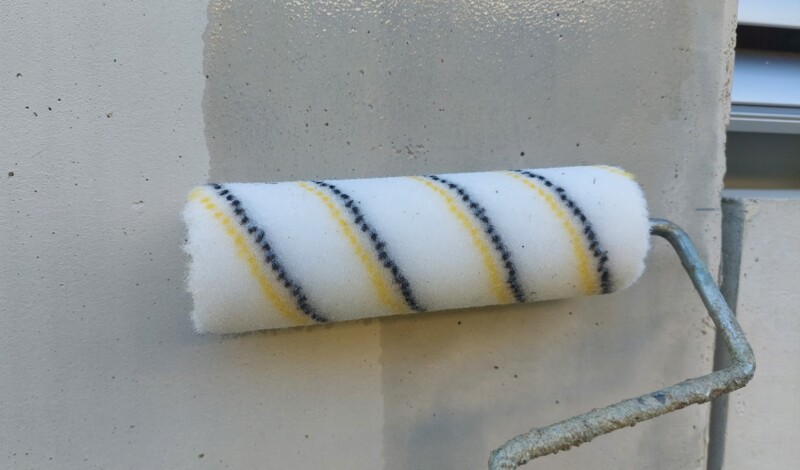 Roll-on application of Emcephob
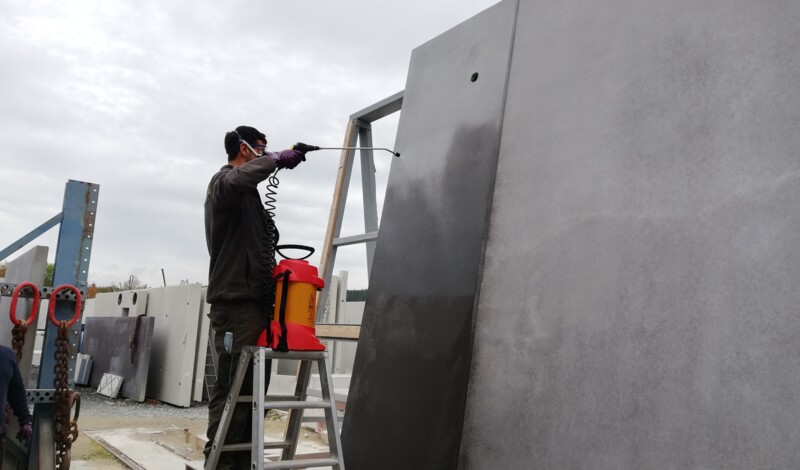 Application by spraying Emcephob
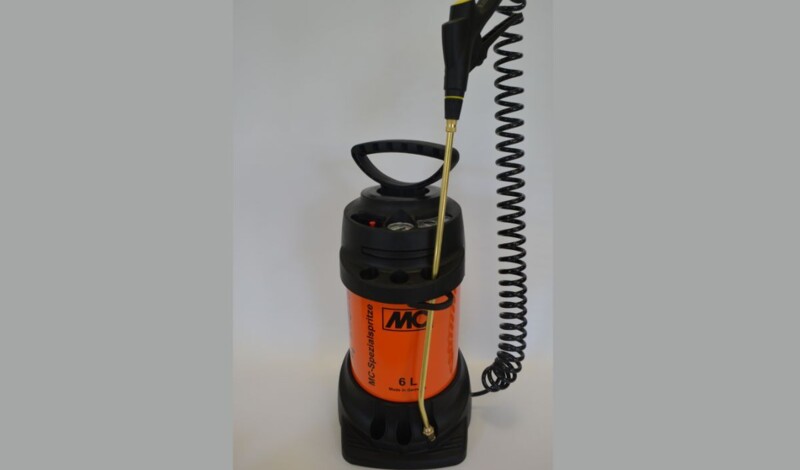 MC special sprayer for spraying hydrophobic agents
The result: reduced water absorption and increased durability of concrete
A hydrophobic concrete surface has significantly reduced water absorption because the pores and capillaries have been made water-repellent by the hydrophobic agent. The water vapor diffusion capacity of the concrete is largely retained, so that no sealing effect in the classic sense occurs. The surface usually exhibits a characteristic beading effect, whereby water runs off in droplets and hardly penetrates the pore structure. This leads to a reduced tendency to become dirty and improved protection against freeze-thaw cycles and chloride-containing media. The mechanical structure and appearance of the concrete remain essentially unchanged, as the water repellent does not form a film. Depending on the product used, a slight sheen or darker tint may be visible, but this is not necessarily the case. Overall, the hydrophobic treatment contributes to a significantly increased durability of the concrete surface, especially in exposed locations or in areas subject to high moisture stress.
Conclusion
The right application technique is crucial for the effectiveness of hydrophobic treatments. These agents can only develop their water-repellent properties to the full on suitable, sufficiently dry concrete substrates. Practical application – whether by rolling, spraying, or a combination of both – ensures that the concrete remains protected in the long term without changing its appearance or structure.
Want to find out more?
Read the first parts of our hydrophobic agents MC pedia series to find out about the basics, effects & normative framework active ingredients, properties, service life.