Germany
 Austria
 Belarus
 Belgium
 Bosnia and Herzegovina
 Bulgaria
 Croatia
 Czech Republik
 Denmark
 Finland
 France
 Georgia
 Great Britain
 Hungary
 Ireland
 Latvia
 Lithuania
 Netherlands
 Poland
 Portugal
 Romania
 Serbia
 Slovakia
 Spain
Spain
 Sweden
 Switzerland
 Ukraine
 Ethiopia
 Ghana
Ghana
 Egypt
Egypt
 Guinea
 Israel
 India
India
 Kazakhstan
 Malaysia
 Singapore
 United Arab Emirates
 Vietnam
 Taiwan
 Philippines
 New Zealand
 Australia
 Canada
 Brazil
 Paraguay
 Uruguay
 Bolivia
 Chile
Chile
 Peru
Peru


Strengthening structures with CFRP
Strengthening structures with CFRP
Reinforcing structural components with CFRP systems
13 Jul 2026
Many concrete structures such as bridges, parking garages, and residential or commercial buildings were originally designed for loads and uses that have long since been exceeded. Increasing traffic volumes, changes in use, or simply the ongoing aging process can put their structural integrity at risk. Retrofitting structural components with CFRP systems shows how existing structures can be upgraded with minimal intervention and made fit for the future.
In practice, structural engineers often rely on additional steel beams or shotcrete with added reinforcement for retrofitting. These methods are proven, but they come with significant disadvantages. They require space, increase dead load, and alter the geometry of the structural component. Especially in slabs, downstand beams, or parking garages with limited clear height, this can quickly become a deciding exclusion criterion. In addition, these methods involve long construction times, extensive site setup, and closures that can severely disrupt ongoing operations.
CFRP systems as a modern alternative for retrofitting structural components
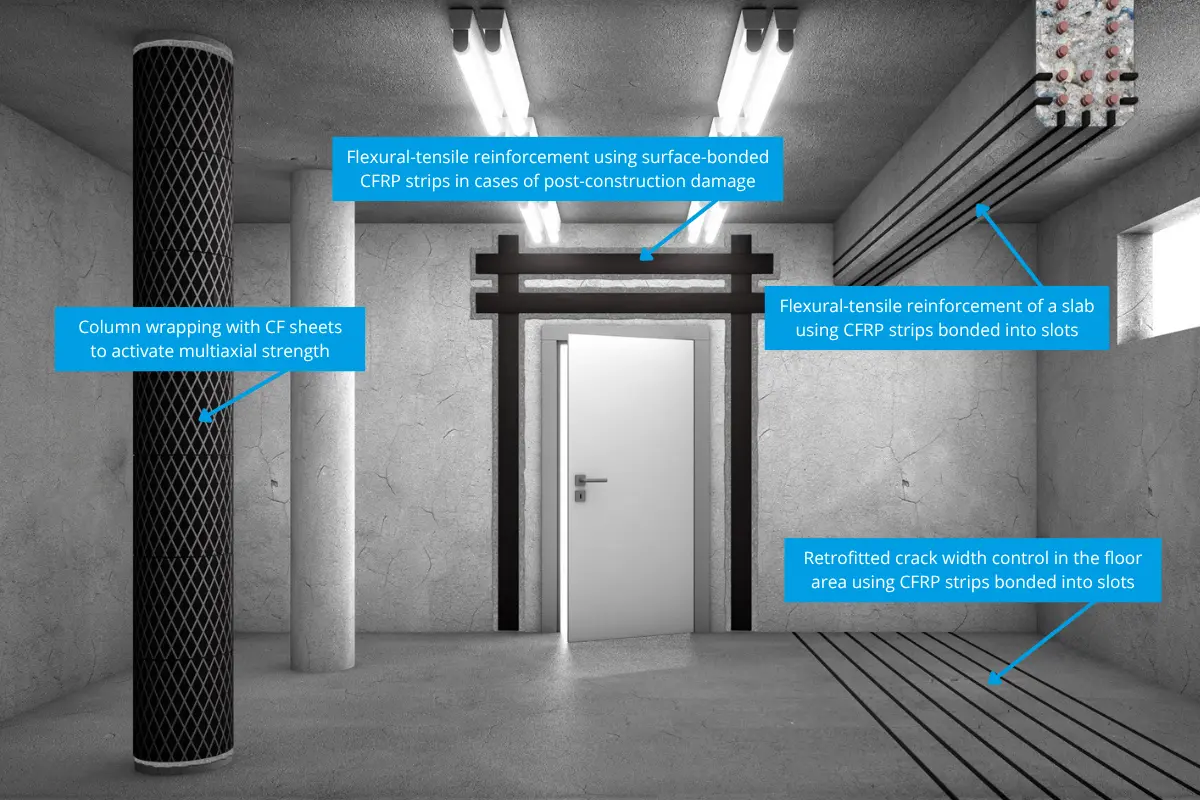
Carbon fibre reinforced polymers (CFRP) offer an alternative here. They allow targeted strengthening exactly where it is structurally required: in the critical tensile zones of concrete components. Depending on the requirements of the strengthening measure, CFRP systems are used either as laminates or as flexible carbon fibre fabrics. Both variants are characterised by very low self-weight, high tensile strength, and minimal build-up thickness.
Compared with conventional strengthening methods requiring a build-up of 10 to 20 cm, CFRP laminates with a material thickness of less than 5 mm remain almost invisible. They can be bonded to the surface or anchored into grooves in the concrete. The existing geometry of the structure remains unchanged. This is a decisive advantage, particularly in confined spaces or in listed historic buildings.
Faster construction progress due to low weight with CFRP systems
Another practical advantage of CFRP systems is their easy handling. Due to their low weight, no elaborate technical measures are required, and additional shoring during installation is unnecessary. While shotcrete only reaches its full load-bearing capacity after around 28 days, CFRP strengthening systems can be loaded after just a few days. This significantly reduces labour requirements as well as construction and closure times and enables rapid recommissioning.
MC’s CFRP systems for many structural challenges
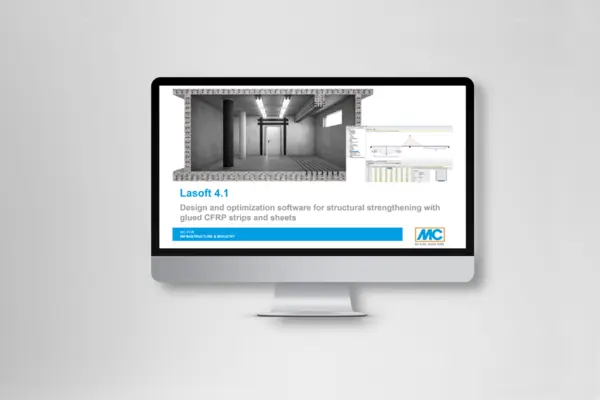
MC-Bauchemie’s CFRP strengthening systems offer all of these advantages and can be used for a wide range of applications, from the localised strengthening of individual components to the comprehensive upgrading of entire structures. With Lasoft, MC also provides the corresponding design software.
Find out more about this topic in our MC pedia article:
https://www.mc-bauchemie.com/mcpedia/retrofitting-structural-elements-with-cfrp-systems.html