MC-Floor Screed is very well suited to the rapid rehabilitation of industrial floors exposed to heavy wear and tear thanks to its fast hardening action and its high resistance. It is thus ideal for weekend job sites.
Press release

New fast industrial floor system

With MC-Floor Screed, floors such as those in production facilities, storage areas and material handling areas – including those with wheeled truck access – can be repaired in just one day.

Fast industrial floor system for weekend job sites

6 Apr 2017

MC-Bauchemie has developed a new industrial floor system in the form of MC-Floor Screed. With this, floors such as those encountered in production facilities, storage areas and material handling areas – including those with wheeled truck access – can be repaired in just one day. And after just one or two days more, they are ready for pedestrian and wheeled traffic usage again. MC-Floor Screed is very well suited to the rapid rehabilitation of industrial floors exposed to heavy wear and tear thanks to its fast hardening action and its high resistance. It is thus ideal for weekend job sites. With MC-Floor Screed, companies requiring such repair measures are able to reduce both downtime and cost.
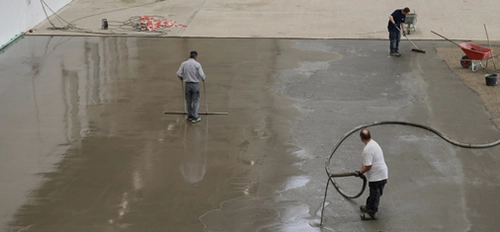
MC-Floor Screed is very well suited to the rapid rehabilitation of industrial floors exposed to heavy wear and tear thanks to its fast hardening action and its high resistance. It is thus ideal for weekend job sites.  <br>© MC-Bauchemie 2026

MC-Floor Screed is very well suited to the rapid rehabilitation of industrial floors exposed to heavy wear and tear thanks to its fast hardening action and its high resistance. It is thus ideal for weekend job sites. MC-Bauchemie 2026

MC‘s new industrial floor system MC-Floor Screed comprises the adhesive emulsion MC-Floor Screed BS, the easy-flowing and thus self-levelling cement-bound industrial floor MC-Floor Screed 10 and the fast-reacting speciality compound MC-Floor Screed 25

MC-Floor Screed 10 for the repair of damaged, highly stressed industrial screeds

MC-Floor Screed 10 is the new rapid-hardening, high-strength industrial floor covering from MC for self-levelling layer thicknesses between 10 and 30 mm. It is also ideal for quickly repairing heavily worn industrial floors. The easy-flowing, single-component, cement-bound industrial floor is easy to apply and exhibits high load capacities even at low layer thicknesses. The substrate must be prepared in accordance with the relevant standards and primed with the adhesive emulsion MC-Floor Screed BS. MC-Floor Screed 10 is then laid fresh-in-fresh onto the primed surface and spread with an agitation rod. 

Overcoatable after 24 hours and fully accessible after 48 hours

The MC-Floor Screed 10 industrial floor system hardens virtually free of shrinkage and stress, can be walked on after just two hours and, after 24 hours, coated with products from the MC-DUR range. For fast weekend job sites, overcoating can be effectively carried out by a product from the MC-Floor TopSpeed range, the high-speed coating system from MC.
For this, the surface is primed with MC-Floor TopSpeed SC and then, depending on requirements, scattered with quartz sand. The next coat can be applied after a waiting period of just two hours. And after around 48 hours, the industrial floor is ready for reuse. It reaches a compressive strength of 20 N/mm² after one day, rising to 35 N/mm² after seven days. Following complete hydration, the final compressive strength value is  45 N/mm².
MC-Floor Screed 25 for layer thicknesses between 25 and 70 mm
The fast-reacting speciality compound MC-Floor Screed 25 is mixed with 0 to 8 mm grain screed sand, pretreated in its earth-damp state in accordance with the applicable standards, and then laid onto a substrate primed with MC-Floor Screed BS. It is then levelled and smoothed by hand using standard height gauges. MC-Floor Screed 25 is suitable for repairing areas with layer thicknesses between 25 and 70 mm. It hardens quickly and is shrinkage-free, enabling it to be walked on after approximately four hours. It is ready for overcoating after two days. After three days, it reaches a compressive strength of 35 N/mm², rising to 45 N/mm² after 28 days.

pageImpression = pageImpression + 1; }); barba.init({ preventRunning: true, timeout: 5000, /* for debuggin usi this parameters debug: false, logLevel: 'debug', */ /*sync: true,*/ // define a custom function that will prevent Barba // from working on links that contains a `prevent` CSS class prevent: ({ el, event, href }) => { if (!el) { return false; } if (el.href && el.href.includes('landingpages')) { return true; } if (el.classList && el.classList.contains('prevent')) { return true; } return false; }, preventScroll: true, scroll: false, views: [], transitions: [ { name: 'header-transition', sync: false, from: { custom: ({ trigger }) => { if (trigger.classList && trigger.classList.contains('headerFlip')) { transistionImage = trigger.getElementsByClassName("transitionImage")[0]; if (typeof transistionImage == "undefined") { return false; } transisitionEffect = getRandomInt(1); return true; } return false; } }, async leave(data) { if (transistionImage === null) return; // can be null, return if null to not throw an error if ( transisitionEffect == 0) { const done = this.async(); let element = transistionImage; let state = Flip.getState(element); let headerImage = document.getElementById('headerImage'); headerImage.removeChild(headerImage.getElementsByTagName('img')[0]); let headerContent = document.querySelector('.headerContent'); gsap.to(headerContent, { opacity: 0, }); let content = document.querySelector('.content'); gsap.to(content, { opacity: 0, }); headerImage.appendChild(element); scroll(0,0); Flip.from(state, {duration:0.9, ease: "power1.inOut", scale: true, absolute:true,}); await delay(900); // Der await Operator wird genutzt, um auf einen Promise zu warten. Er kann nur in einer async Funktion benutzt werden. done(); } }, enter(data) { window.scrollTop = '0'; let content = data.next.container.querySelector('.content'); gsap.from(content, { opacity: 0, }); let headerContent = data.next.container.querySelector('.headerContent'); gsap.from(headerContent, { opacity: 0, delay: 0.5, }); }, after(data) { } }, { name: 'microsites_sliding_scroll', sync: true, from: { custom: (data) => { const { trigger, current, next } = data; function getParent(pathname) { const parts = pathname.split('/').filter(part => part !== '') return parts.length > 1 ? parts[parts.length - 2] : parts[0] || null } if (trigger === 'popstate' || trigger === 'back' || trigger === 'forward') { return false; } if(trigger.classList.contains('microsites_sliding_scroll') || trigger.classList.contains('sliding_scroll')){ return true; } if(current.namespace == 'template_138' && next.namespace == 'template_138') { return getParent(current.url.path) === getParent(next.url.path) } return false; } }, to: { namespace: [ 'template_120', 'template_138', ] },async leave({ current, next, trigger }) { const debug = window.debug; if (debug) console.log('Debug mode enabled'); const done = this.async(); const menuindexCurrent = +current.container.querySelector('[data-menuindex]').dataset.menuindex; const menuindexNext = +next.container.querySelector('[data-menuindex]').dataset.menuindex; const nextContent = next.container.querySelector('.content'); const currentContent = current.container.querySelector('.content'); let xPerc = menuindexCurrent < menuindexNext ? 100 : -100; const navbarHeight = document.querySelector('.navbar').offsetHeight; const pageHeight = document.querySelector('.header').offsetHeight; const nextContentHeight = nextContent.offsetHeight; const totalHeight = nextContentHeight + navbarHeight + pageHeight; document.body.style.minHeight = `${totalHeight}px`; const targetScrollY = trigger.classList.contains('microsites_sliding_scroll') ? pageHeight - navbarHeight : pageHeight + navbarHeight; const top = trigger.classList.contains('microsites_sliding_scroll') ? '0px' : '116px'; gsap.set(next.container, { xPercent: xPerc, position: 'absolute', top: top, left: 0, display: 'block' }); const tl = gsap.timeline({ onComplete: () => { gsap.set(current.container, { display: "none" }); gsap.set(next.container, { clearProps: 'position,top,left,xPercent' }); gsap.set(nextContent, { clearProps: 'xPercent' }); document.body.style.minHeight = ''; done(); } }); tl.to(currentContent, { xPercent: -xPerc, duration: debug ? 5 : 0.5, ease: "power1.inOut", }, 0); tl.to(nextContent, { xPercent: -xPerc, duration: debug ? 5 : 0.5, ease: "power1.inOut" }, 0); tl.to(window, { scrollTo: { y: targetScrollY }, duration: debug ? 5 : 0.5, ease: "power1.inOut" }, 0); }, enter({ next }) { gsap.from(next.container, { opacity: 0, }); } }, { name: 'microsites_sliding', sync: true, from: { custom: ({ trigger }) => { if (trigger === 'popstate' || trigger === 'back' || trigger === 'forward') { return false; } if(trigger.classList.contains('microsites_sliding')){ return true; } return false; } }, to: { namespace: [ 'template_120', ] }, async leave({current, next}) { const done = this.async(); const tl = gsap.timeline({onComplete: ()=>{ gsap.set(next.container, {clearProps: 'all'}) gsap.set(next.container.querySelector('.content'), {clearProps: 'all'}) }}) const currentContent = current.container.querySelector('.content') const nextContent = next.container.querySelector('.content') const currentH1 = document.querySelector('.currentPagetitle') const currentIntrotext = document.querySelector('.currentIntrotext') const nextH1 = next.container.querySelector('.pageTitle') const nextIntrotext = next.container.querySelector('.introtext') gsap.set(next.container, { xPercent: 100, position: 'absolute', top: 0, left: 0 }) tl.to(currentContent, {xPercent: -100, opacity: 0, duration: 1, ease: "power1.inOut", onComplete: () => { gsap.set(current.container, { display: "none" }); }}, 0) .to([currentH1, currentIntrotext], { opacity: 0, duration: 0.5, ease: "power1.inOut", onComplete: () => { currentH1.innerText = nextH1.innerText; currentIntrotext.innerText = nextIntrotext.innerText; }}, 0) .to([currentH1, currentIntrotext], { opacity: 1, duration: 0.5, ease: "power1.inOut" }, 0.5) .to(nextContent, {xPercent: -100, duration: 1, ease: "power1.inOut"}, 0) await delay(1000); done(); }, enter({next}){ gsap.from(next.container, { opacity: 0, }); } }, { name: 'default', sync: false, async leave(data) { const done = this.async(); gsap.to(data.current.container, { opacity: 0, duration: 0.5, }); await delay(500); // Der await Operator wird genutzt, um auf einen Promise zu warten. Er kann nur in einer async Funktion benutzt werden. scroll(0,0); done(); }, enter(data) { window.scrollTop = '0'; gsap.from(data.next.container, { opacity: 0, duration: 0.5, }); }, after(data) { // START: Ankur - 15062023 - For Scroll Position History if(scrollHistory[data.next.url.href]) { let scroll = scrollHistory[data.next.url.href]; window.scrollTo({top: scroll.y, behavior: 'instant'}); } // END: Ankur } }, { name: 'self', enter() { }, } ] }); });