 Germany
 Austria
 Belarus
 Belgium
 Bosnia and Herzegovina
 Bulgaria
 Croatia
 Czech Republik
 Denmark
 Finland
 France
 Georgia
 Great Britain
 Hungary
 Ireland
 Latvia
 Lithuania
 Netherlands
 Poland
 Portugal
 Romania
 Serbia
 Slovakia
 Spain
Spain
 Sweden
 Switzerland
 Ukraine
 Ethiopia
 Ghana
Ghana
 Egypt
Egypt
 Guinea
 Israel
 India
India
 Kazakhstan
 Malaysia
 Singapore
 United Arab Emirates
 Vietnam
 Taiwan
 Philippines
 New Zealand
 Australia
 Canada
 Brazil
 Paraguay
 Uruguay
 Bolivia
 Chile
Chile
 Peru
Peru


Which active ingredients are used in modern hydrophobic agents and how long do they last?
Which active ingredients are used in modern hydrophobic agents and how long do they last?
Decades of research and development in the field of water repellents have led to modern silane/siloxane-based systems. Their special material properties enable a high water-repellent effect and thus effective protection of the concrete. However, water repellents are not permanently resistant and must be renewed every two to five years, depending on the substrate.
Silanes and siloxanes as the basis for effective hydrophobic agents
Originally, silicones and silicone resins dissolved in solvents were used. However, these did not catch on because they had low penetration properties and insufficient alkali resistance. To counteract these weaknesses, alternative raw materials were developed based on low-molecular alkyl silanes and oligomeric siloxanes. Modern hydrophobic treatment systems are therefore usually silane/siloxane-based, but are only available as mixtures, for example, solvent-based or aqueous. Only after these substances have been applied and cured on the concrete substrate does the end product form – a pore-lining silicone resin film that can be regarded as chemically bonded in the concrete. This layer does not form a film, but varies in depth depending on the penetration depth and – since it is bonded in cross-section – cannot be easily removed. At the very least, it cannot be mechanically removed without removing the layer close to the surface.
High reduction in water ingress thanks to protective material properties
Both enable a reduction in water ingress into the component surface, which can have varying degrees of effectiveness. Over time, this effect wears off because hydrophobic agents are relatively chemically inert, meaning they no longer react with potential reaction partners such as air and water over time. After application, the silicone resin film reacts completely within its specific reaction time. Over time, this film loses its effectiveness due to weathering and is therefore only considered temporary protection. In principle, hydrophobic concrete surfaces therefore exhibit minimized penetration of water and thus also of transported chlorides. This in turn leads to increased protection of the entire structure against frost and deicing salt stress. In addition, there are visual advantages: surfaces remain dry longer in rain and are largely resistant to biological infestation.
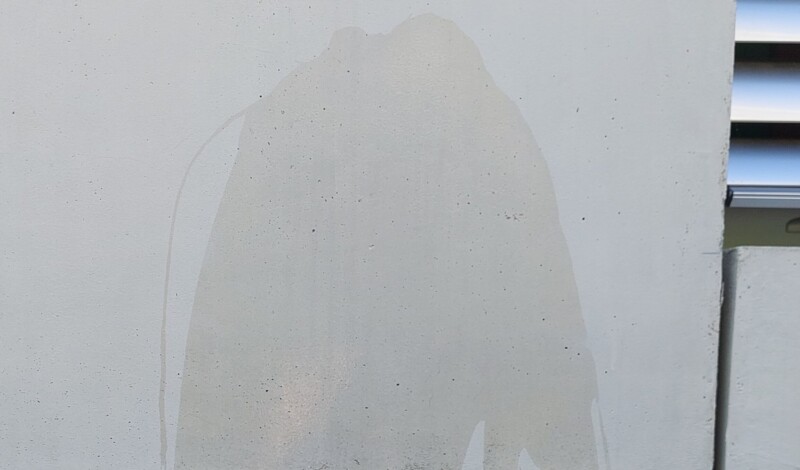 Water on non-hydrophobic concrete
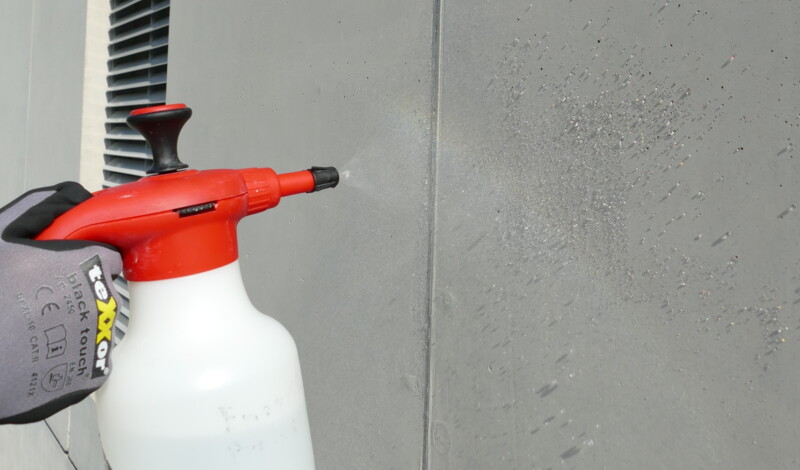 Water on hydrophobic concrete
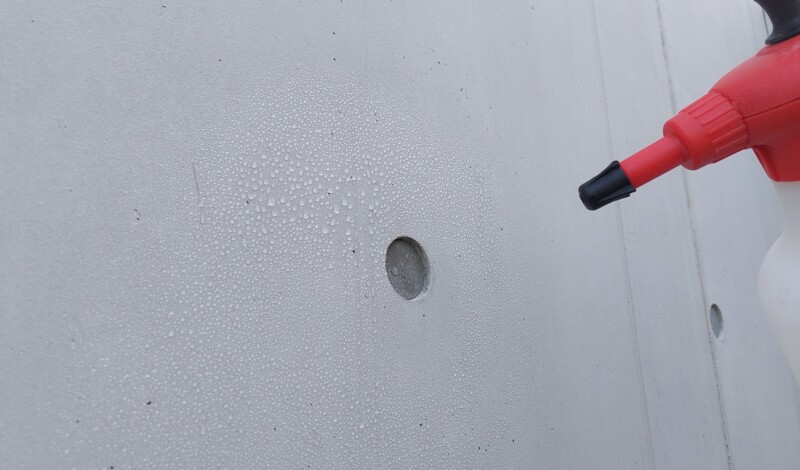 The surface usually shows a characteristic beading effect
The durability of modern hydrophobic systems
Due to their chemical structure, hydrophobic agents are UV-stable, but they are degraded by rain or reactive components in the atmosphere. This initially leads to uneven water absorption and can later cause visible color changes. As a result, the overall appearance can be impaired. Due to these aging processes, hydrophobic agents generally have a significantly shorter service life than the concrete itself and must therefore be renewed several times during the entire service life of the concrete. In practice, it has been shown that these systems must be renewed approximately every two to five years, depending on the absorbency of the substrate. The manufacturer's instructions must always be followed.
Conclusion and outlook
Modern silane/siloxane-based hydrophobic agents have established themselves as an efficient temporary protection for concrete surfaces. They significantly reduce water and chloride ingress and thus contribute significantly to protection against frost and de-icing salt damage. Despite their chemical stability, however, they are susceptible to aging and must be renewed at regular intervals. Both the penetration depth and correct application to the respective substrate are crucial for their effectiveness.
Want to find out more?
In the third part of our series, we will therefore deal with the practical application of hydrophobic treatments. We will show which methods are used in practice, how to apply them correctly and what visible results can be achieved on the concrete surface.